Goalball
Overview
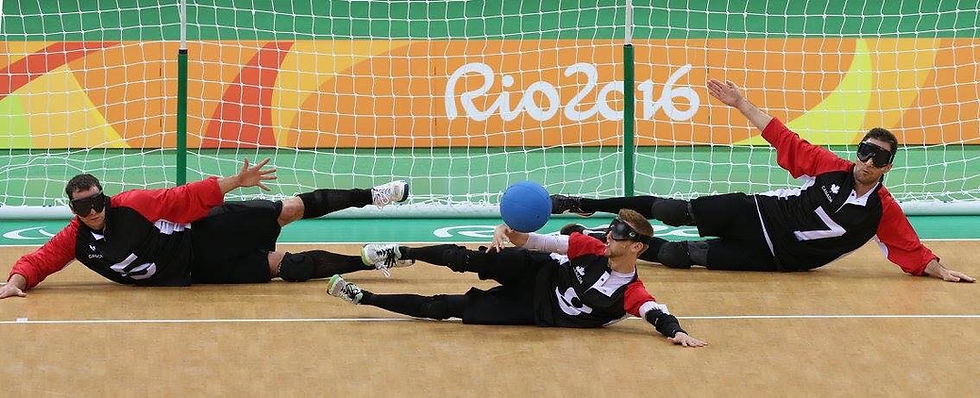
Goalball is a sport designed for athletes with visual impairments. It is a one-of-a-kind, fast-paced team sport requiring skill, speed, and precision, played by both men's and women's teams.
Watch this!
Who can Play?
At the international level, all players are visually impaired and have less than 10% vision. Eligible players are classified into three categories:
-
B1 (totally or nearly totally blind)
-
B2 (partially sighted with a higher degree of impairment)
-
B3 (partially sighted with the least severe impairment)
Within Canada, sighted players can participate and compete up to national level.
Regardless of their classification, all competitors wear opaque eyeshades to ensure a level playing field.
Rules
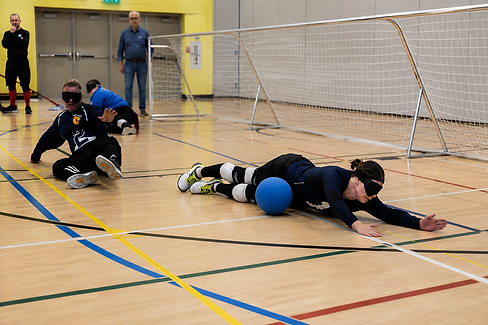
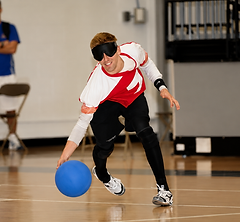
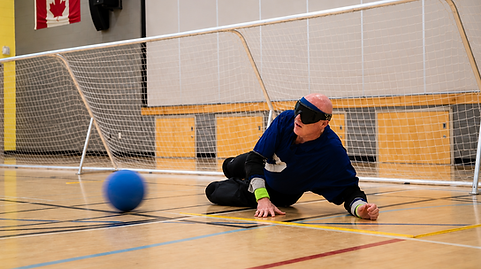
Goalball is played on a gym court where teams try to score by rolling a 1.25 kg ball with internal bells into the opponent’s net, using a bowling motion, while defenders block with their bodies.
Each team has six players, but only three (one centre and two wingers) are on court at any given time.
The court has tactile markings to help players orient themselves, and the audience is required to be silent during play so athletes can listen and react.
A game lasts 24 minutes, divided into two 12-minute halves with a three-minute halftime. Main rules include: the ball must touch the floor before crossing the highball line, throws must cross center line within ten seconds, and penalties apply for violations.
Did you know?
Within Canada, sighted players can participate and compete up to national level.
Equipment
Goalball is played with a specialized 1.25-kilogram ball, which contains internal bells that rattle as it moves. Tactile tape or rope lines are used to mark the court so athletes can feel their position and orientation underfoot. All competitors also wear opaque blackout eye shades during play. Also, some athletes wear padded knee and elbow guards to protect themselves while diving and blocking.
At Parasport NB programs, all equipment is provided.
History
Goalball was invented in 1946 as a way to support the rehabilitation of veterans who had lost their sight while serving in World War II.
In 1976, it was introduced to the world at the Paralympic Games in Toronto and a women’s tournament was added at the 1984 Paralympic Games.
The Canadian women’s team has been particularly successful with five Paralympic Games medals including back-to-back gold in 2000 and 2004. The men won the silver in 1996.